Overview
A globally-grounded, credible starting point that national or sub-national authorities use as raw material to prepare their own early action protocols via adaptation workshops (per the IFRC/PAPE recommendation). Users come out of that process with their own approved action protocol library that is validated, politically endorsed and institutionally owned.
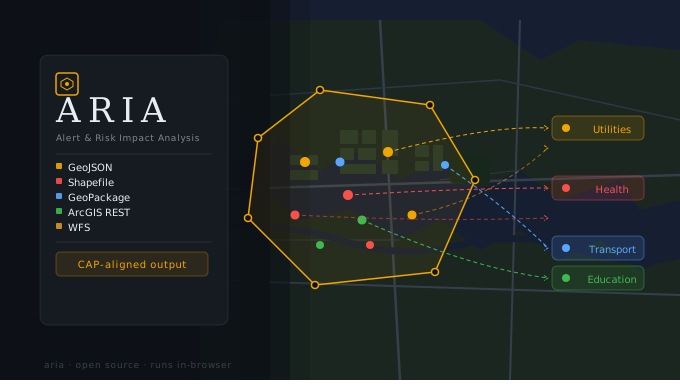
This is linked in ARIA, where users can draw or import polygons over affected areas and the system instantly retrieves demographic data, infrastructure information, and exposure statistics from pre-defined libraries. The data can be automatically connected via ARIA-Lex into pre-validated warning language that can be ported directly into Common Alerting Protocol (CAP).
Customized, CAP result is faster, more accurate warnings that help communities prepare for and respond to emergencies. What once took hours of manual data gathering and analysis can now happen in seconds.
What once took hours of manual data gathering can now happen in seconds. Warnings can be contextual, action-oriented and community-focused without sacrificing warning speed.
The Challenge
Early Warnings are easy. Getting an observed phenomenon to trigger a loud noise is the simple part. But action is the hard part. Warnings that are too unspecific (a siren), to generic ("heavy rainfall will affect your area"), or too slow do not produce the kinds of actions that will save lives and assets. Some communities have built-in impact-based thresholds where, if the temperature or precipitation is anticipated to pass a threshold, some standard language is issued. But for people to really take action, the messages should be specific and clear and actionable. The Early Warning needs of a teacher caring for 30 young people are different from a fleet manager for a logistics firm or a safety operator at a power plant.
Key Features
Technical Implementation
ARIA-Lex can be used as a standalone database and plugged into existing Early Action protocols or connected to ARIA to extract automated messages that are preapproved by the relevant authorities. All messages are by-default "unvalidated" and deactivated and intended only as a seed library for official validation. When seed messages are validated or edited and then validated, they can be easily activated and ported directly into existing protocols.
| ID | Theme | Description |
|---|---|---|
| A1 | Situational awareness & monitoring | Receiving, verifying, and tracking hazard information as the risk picture evolves. |
| A2 | Protective action, physical safety | Evacuation, shelter-in-place, and securing structures before impact. (IFRC PAPE core theme) |
| A3 | Resource & supply pre-positioning | Stockpiling and pre-authorising release of supplies, fuel, and funds. (WFP/FAO anticipatory action) |
| A4 | Health & medical preparedness | Pre-positioning medical supplies, surge capacity, and care continuity. (WHO ERF) |
| A5 | Vulnerable population identification & outreach | Identifying and reaching elderly, disabled, pregnant, and isolated groups before impact. (IFRC, UNICEF, WHO) |
| A6 | Safeguarding & duty of care | Protecting children, staff, and beneficiaries from harm and exploitation. (UNICEF, INEE) |
| A7 | Mental health & psychosocial support (MHPSS) | Psychological first aid and staff wellbeing during prolonged events. (WHO ERF, IASC MHPSS) |
| A8 | Risk communication & public information | Clear, trusted public warnings, including countering misinformation. (IFRC RCCE, ITU) |
| ID | Theme | Description |
|---|---|---|
| B1 | Coordination & inter-agency activation | Activating EOCs, ICS structures, and inter-agency coordination mechanisms. |
| B2 | Infrastructure protection & hardening | Reinforcing, relocating, or shutting down vulnerable physical assets before impact. |
| B3 | Service continuity & backup activation | Activating backup systems, redundant pathways, and continuity-of-operations plans. |
| B4 | Network & operational rerouting | Rerouting traffic, supply chains, or data flows away from the hazard area. |
| B5 | Workforce & personnel management | Staff safety, shift scheduling, and surge roster activation. |
| B6 | Financial & legal pre-authorisation | Unlocking emergency funding and pre-authorising procurement. (trigger-based financing) |
| B7 | Data, records & documentation protection | Backing up records and protecting legal documents across sectors. |
| B8 | Livelihoods & asset protection | Protecting livestock, crops, and productive assets. (FAO, WFP) |
| B9 | Regulatory & policy emergency powers | Invoking emergency legislation and international frameworks (IHR, ICAO). |
Download
ARIA-Lex.db is a standard SQLite file. Open it in ARIA to generate warning language automatically, or open it in any database browser to read, edit, and validate the messages directly.
The database is what ARIA reads. For a plain, readable table of every message, for a facilitated review session, open the browsable version instead of the .db file.